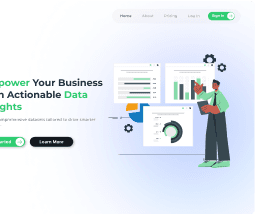
G2M Service Dashboard
Background, Goals, and Key Focus Areas
This project involved the end-to-end redesign and development of the Find My Apartment website, from initial UX exploration in Figma to final implementation in Webflow. The goal was to improve clarity around the service offering, build user trust, and optimize the site for lead generation without over-engineering the experience.
The redesign focused on simplifying the user journey, strengthening the value proposition, and establishing credibility through clear messaging and social proof. Design decisions were driven by business outcomes, helping users quickly understand that the service is free, how it works, and why they should trust it.
Once the design system and key flows were finalized in Figma, the site was built in Webflow with an emphasis on consistency, responsiveness, and scalability. The final result is a clean, conversion-focused website that balances usability, brand clarity, and real-world implementation constraints.

Figma
Used for UI design, component systems, interaction flows, and conceptual animations.
unDraw
Minimal, semantic illustrations aligned with the brand tone.
Freepik
Used for abstract backgrounds and main visual elements and illustrations needed.
Approach, Architecture &
Key Decisions
The solution balances user needs, business goals, and technical feasibility resulting in a conversion-focused website that feels approachable, trustworthy, and ready for real-world use.

Approach Used for Design
The primary objective of the solution was not only to improve the website's visual clarity, but also to increase qualified leads flowing from the website into the CRM. The experience needed to actively encourage user interaction, guide exploration, and convert interest into meaningful inquiries.
What we designed or implemented and Why
To drive more client inquiries from the website into the actual lead for the agents, the experience was structured around discoverability and intent-based conversion. Rather than a single generic flow, the website introduced city-specific pages, allowing users to explore content relevant to their location.
Each city page was designed to:
- Provide localized context and clarity
- Encourage deeper exploration
- Capture user intent through focused inquiry forms
Forms were positioned strategically within the flow to feel like a natural next step rather than a hard stop, helping users share their requirements while staying engaged with the experience.

Key Design & Layout Decisions
Design decisions around color, layout, and hierarchy were made to support engagement and conversion. A clean, neutral color palette was used to establish trust and reduce distraction, while accent colors were applied selectively to highlight calls-to-action and form interactions.
Layouts emphasized:
- Clear visual hierarchy to guide attention
- Scannable content blocks to encourage exploration
- Consistent patterns across city pages to create familiarity
- Form build in very simple and easy manner for users
These choices ensured that users could quickly orient themselves, explore confidently, and take action without friction.

Workflow Design
Discovery & Goal Alignment: The process began with understanding the client's business goals and success metrics, with a strong focus on increasing qualified leads flowing from the website into the CRM. At this stage, we aligned on user intent, key conversion actions, and the role the website needed to play in driving engagement and inquiries.
Brainstorming & Experience Mapping: Early brainstorming sessions explored different ways users might discover the service, navigate city-specific content, and decide to submit a query. User journeys were mapped to identify moments of exploration, trust-building, and conversion.
Information Architecture & Low-Fidelity Exploration: Based on initial insights, the website structure was defined with a clear hierarchy. Low-fidelity layouts were created to validate content flow, section ordering, and interaction patterns before moving to high-fidelity design.
Results, Learnings & Measurable Outcomes
Solutions offered after overviewing the requirements
Conversion-First Homepage Experience
The homepage was designed to immediately communicate value and guide users toward action through a strong hero message, city-based exploration, motion-supported sections, testimonials, and a clear final CTA. This structure reduces bounce rates and creates a smooth path from discovery to lead submission.
City-Driven Funnel for Lead Generation
City detail pages act as focused conversion funnels, combining local positioning, "how it works" clarity, testimonials, and repeated CTAs. This enables the client to confidently run city-level ad campaigns, driving high-intent traffic directly into qualified lead forms.
Optimized Lead Capture & Form Experience
Contact and query forms were intentionally minimal and expectation-setting, collecting only essential information while pre-selecting context such as city. This reduces friction, improves completion rates, and ensures cleaner lead data flowing into the CRM.
Trust-Building Through Process & People
Process and About pages humanize the brand and explain service complexity through step-based layouts, motion cues, and team visibility. This builds confidence, lowers hesitation, and supports users who need reassurance before submitting inquiries.
Content & Growth Enablement
Blog and career sections were designed with modular layouts and filters to support SEO, hiring, and long-term content growth. These pages help attract organic traffic, establish authority, and support business expansion beyond paid acquisition.
Business-Ready, Scalable Design System
All pages were built on reusable components, CMS-driven structures, and consistent interaction patterns. This allows the client to scale cities, campaigns, and content quickly supporting ongoing marketing, lead generation, and operational growth without redesign.
Scalability, Optimization & Roadmap
What Could Be Improved from a Design Perspective
Introduce progressive or multi-step form flows to reduce friction during query submission, supported by conversion tracking to analyze drop-offs and improve completion rates across devices.
Designer Growth & Learnings
Optimize CMS structures to support growing content types (cities, blogs, testimonials, services) while ensuring all components remain modular, reusable, and adaptable without visual or functional regression.
Next Design Opportunities
Implement advanced web tracking and conversion analytics to measure user behavior, CTA engagement, campaign performance, and city-level conversions, enabling data-informed design and optimization decisions.
Scaling Considerations
Evolve the lead-handling portal to better manage incoming leads with clearer qualification stages, prioritization, and visibility across teams, bridging marketing, operations, and agents more effectively.
Optimization Ideas
Use CMS-driven dynamic content and filtering to deliver personalized landing pages by location, service type, or persona, complemented by refined micro-interactions and motion to increase engagement.
Next Design Opportunities
Implement advanced web tracking and conversion analytics to measure user behavior, CTA engagement, campaign performance, and city-level conversions, enabling data-informed design and optimization decisions.
Some Snaps of the Project



Your satisfaction is our top priority. Reach out to us and let's start a conversation
